Meditation Practice
A thirty minute daily sitting that survives real life
Duration is negotiable, regularity is not. Here is a half hour sitting that fits before work, with a roadmap you can shorten to ten honest minutes on bad mornings.
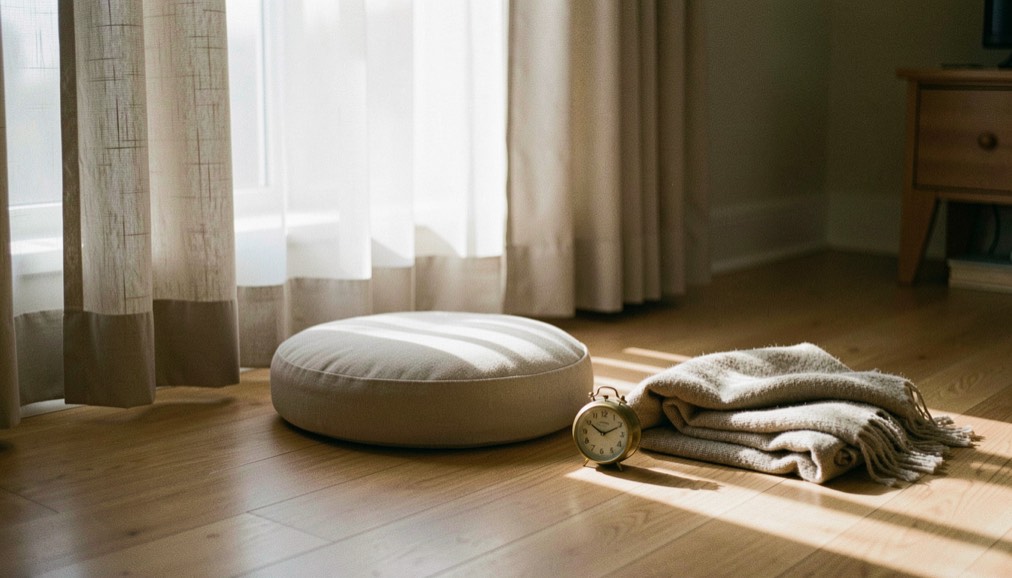
Most lay advice about daily practice fails in one of two directions. One school demands a schedule no employed person keeps past the second week; the other mumbles that any practice is beautiful, which is how practice quietly stops. The canon takes a third line. The gradual training it describes, for instance to Ganaka Moggallana (MN 107), is a ladder of small, keepable disciplines, and the refrain of the discourses on practice is development, which is a word for things done repeatedly. This guide builds a thirty minute sitting on that logic: modest, fixed, and impossible to romanticize.
The shape of the half hour
Thirty minutes divides cleanly into a settle, a main course, and a close. The divisions are not ornaments; each one answers a known failure. The settle absorbs the first minutes of wandering so they stop being evidence of failure. The main course stays with one method so depth has a chance. The close reviews and hands the mind back to the day, so the sitting connects to the next hours instead of evaporating at the kettle.
| Minutes | Phase | What happens | If the mind is loud |
|---|---|---|---|
| 0 to 5 | settle | posture taken, three long breaths, attention to the body’s weight | stay here; loudness is not disqualification |
| 5 to 25 | main practice | the first tetrad of MN 118: knowing long and short breaths, the whole body of breath, calming | return at the out breath, no commentary |
| 25 to 28 | widen | attention opens to the whole body sitting, then to sound arriving and leaving | widen the body only; sound practice comes later |
| 28 to 30 | close | one line of review, then the first intention for the morning said silently | the line can be one word |
Anchoring the habit where life already has a seam
The time of day matters less than the anchor beside it. A sitting that attaches to an existing routine, the kettle, the school run, the empty desk before login, survives; a floating intention to sit "in the morning" dies by Thursday. Morning has two real advantages worth paying for: the hindrance load is lower, and the day cannot yet argue. Evening sittings work when morning is genuinely impossible, with one honest warning: an evening sit is reviewing a day, not preparing one, and the review tone suits the evening reflection better than the breath. Whichever slot you choose, the Dhamma notebook takes one dated line per sitting, which is the cheapest known antidote to self deception about consistency.
The ten minute floor that keeps the practice alive
Life will interrupt: illness, travel, small children, a flight at six. The all or nothing habit treats interruption as failure and then collects failure as a reason to stop. The canon’s own image for training is gradual, and the honest translation of gradual for a working adult is a floor, not a ceiling. The floor here is ten minutes: settle for two, first tetrad for seven, close for one. The roadmap compresses without changing its bones. A week of ten minute sittings keeps the thread taut and costs almost nothing; a week of zero sittings hands the habit to the weather.
A checklist for the morning of
The night before decides the morning
- Cushion or chair placed where the body will actually meet it, not in an aspirational corner.
- Timer set and left beside the cushion, phone charging in another room.
- The first activity after the sitting chosen in advance: kettle, shower, page of the sutta.
- Alarm named for the sitting, not for waking, so the ring is a summons and not a grievance.
- Notebook open to today’s date with the pen on top, so the close has somewhere to land.
Common mistakes
The classic mistake is duration inflation: setting forty minutes because a book said so, keeping it for nine days, and quitting with a story about not being suited to practice. Set the timer at thirty or below and keep it for a month before raising it. The second is mid sitting logistics: checking the time, adjusting the phone, planning breakfast inside the main course; the settle exists precisely to absorb logistics so the main course can refuse them. The third is grading the sitting, an exercise in which the mind reviews the mind and finds both wanting. The fourth, most respectable of the four, is reading about sittings instead of keeping them; this notebook is structured so the reading costs twenty minutes and the sitting costs thirty, and the ratio is the point.
If you take one thing from this guide
Decide the slot, set the floor, and let the calendar argue instead of the mood. If a thirty minute sitting before work holds for a month, raise it by five minutes and see whether the month repeats. If the mornings collapse for a legitimate reason, drop to the ten minute floor and keep the evening reflection, and call that a kept practice rather than a broken one. The half hour is a container, not a virtue; the content is the first tetrad, the notes, and the honest ledger in the notebook by the bed.